How a new development CRM can help sell your next project
You're a few months from launching your next project. The renderings are done, the sales gallery is booked up; pricing is nearly final. Now you need a system to capture & qualify registrants, allocate units, and get contracts signed.
A common, general-purpose CRM may seem like a decent option. But: your launch isn't a typical sales pipeline, and a generic CRM isn’t optimized for the niche details of new development sales, such as what a unit, a hold, or a deposit schedule is.
What do you actually need from your CRM?
The success of your launch often depends on the prep that happens weeks before sales open, much of which occurs inside your software. Your system should allow you to:
- Segment buyers by persona, such as investors and families, and follow up with each differently.
- Track units and holds in real time, so your team works from one source of truth.
- Apply deposits, commissions, and incentives consistently and correctly across every deal.
- Adjust pricing and deposit structures quickly as demand shifts.
How Spark differs from a generic CRM
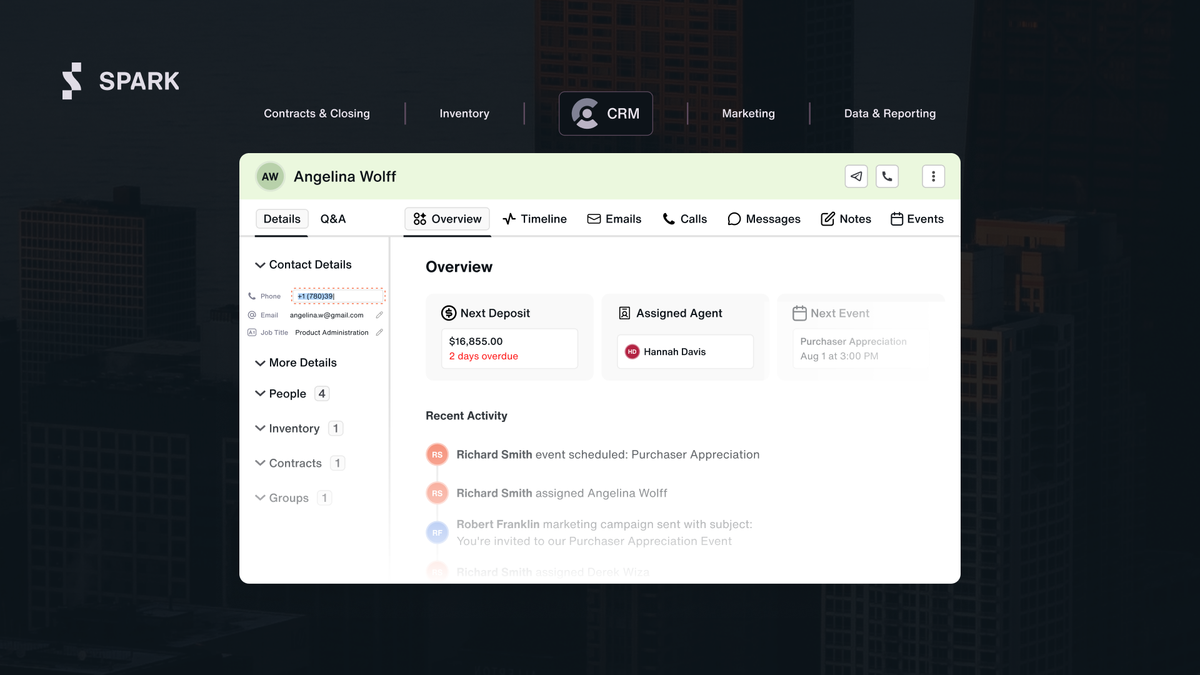
A generic CRM often only covers your contacts. This means the rest of the sale process ends up in spreadsheets, PDF price lists, and a separate signing tool. On the other hand, Spark not only covers your contacts, but also your units, contracts, and closings in a single tool that’s built for new home sales.
1. Qualify prospects the way real estate works
Your registrant list mixes end-users, out-of-market investors and brokers registering for clients. Spark's CRM helps you sort them from day one with:
- Registration forms that feed prospects straight into your database.
- A flexible rating system lets you define hot, warm and cold the way your team works.
- Smart Groups, which segment leads automatically so each persona gets the right message.
- Automated follow-ups and agent tiers that keep buyers and your top brokers engaged.
2. See every unit connected to every buyer
A generic CRM knows your prospects but not your units. In Spark, inventory and contacts share one database, so you always know which buyer and broker are attached to each suite. Spark provides:
- Digital request forms that let you collect and allocate unit requests before launch.
- A live stacking plan that shows the status of your whole building in real time.
- The ability to make mass price adjustments that let you reprice many units at once as demand shifts.
- Parking, storage and upgrades are allocated with the unit and carried into the contract.
Worry no more about double-booked units or using out-of-date spreadsheets on launch day.
3. Sign and close without leaving Spark
Unlike with generic CRMs, the most important part of your deal remains within Spark. With all buyer, unit, price and deposit schedule information already hosted in Spark, you won’t require any separate signing program. Spark Sign provides:
- A completely integrated signing tool that allows you to manage the full contract lifecycle and removes the need for third-party signing tools like Docusign or Avesdo.
- Coverage of the full negotiation process, including marking up files before & during the signing process, correcting errors found mid-signing, and the negotiation of key clauses.
- Markup and annotation tooling, allowing you to map signatures and initial spots to each signatory, strikethrough text, and apply other supported annotations.
- Enterprise-grade security, with SOC 2 Type II compliance across all five TSCs, GDPR/HIPAA/CCPA, plus the per-document cryptographic certificates.
Give your launch the edge
A generic CRM manages your contacts, while Spark manages your launch. Our system takes care of who each prospect is, which unit they want, what they've been offered and where their contract stands. Built on 10 years and thousands of project launches, Spark lets your team spend launch week focusing on what truly matters: selling your project.
Planning a launch? Book a demo to see how Spark can sell your next project.